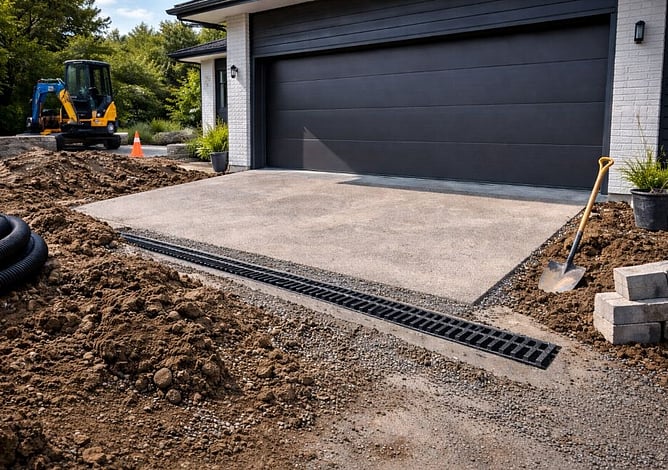
Garage water problems often start before the door is installed. The driveway falls may be wrong, the threshold may sit too low, or runoff may be pushed toward the opening. For DrainPro's Auckland drainlayers, this is where drainage planning needs to start on a new build.
A garage opening is one of the most exposed points in a house. It sits low, connects to hard surfaces, and often receives water from a wide area. Even a tightly fitted door can struggle if surface water flows directly toward it.
Start with the driveway, not the door
Builders often focus on the visible finish first. They choose the garage door style, confirm the cladding, and lock in the driveway layout. The problem is that water movement is already being decided at that stage.
If the driveway falls toward the garage, the door becomes the last line of defence. That is not what a garage door is designed to do. Garage Door installers highlight weather seals as part of its installation and product offering, but seals work best when site drainage is doing its job, too.
Threshold drainage needs to be resolved early
Threshold areas need proper planning before concrete or paving goes down. A grated channel, stormwater pit, or another collection point may be needed to intercept runoff before it reaches the door. DrainPro’s services include taking care of hard surface drainage, including grated channels, stormwater pits, and filtration systems.
This matters even more when the garage is lower than the drive or the street. Small changes in finished level can make a big difference. It is much easier to solve that on paper than after the surfaces are poured.
Auckland conditions make poor planning more obvious
Auckland homes face regular rain, humidity, and, in many areas, coastal exposure. Installers repeatedly refer to local conditions such as wind, rain, salt air, and moisture-heavy weather when discussing material choice, seals, and long-term garage door performance.
Those same conditions also expose a weak drainage design. Water does not need a major storm to become a problem. Repeated runoff across a driveway or apron can be enough to create dampness, ponding, and water entry over time.
Product choices still matter, but they are not the whole answer
Homeowners often start by comparing door styles, finishes, and insulation. That makes sense, especially in a market where appearance and street appeal matter.
People researching Garage Doors Auckland options are usually thinking about design, automation, and durability, but the site levels around the opening still shape how well the finished installation performs.
Rework often starts when trades plan in isolation
Garage thresholds sit at the meeting point of several trades. The builder, concrete contractor, drainlayer, and garage door installer all affect the final result. When one part is confirmed without the others, problems tend to appear late.
A common example is a driveway that looks right but sheds water toward the opening. Another is a channel drain that ends up in the wrong place once the door size or reveal is confirmed.
These are not big design failures, but they are expensive to correct once finished surfaces are in place.
New builds need a wider site view
The garage entrance does not work in isolation. Roof water, side paths, front paving, and nearby hard surfaces can all add to the same collection point. That is why the garage area should be treated as part of the site drainage plan, not as a separate detail at the end.
This is especially relevant on Auckland sites with slope changes or tight frontage layouts. DrainPro’s Auckland team covers a broad area across the north and west, including New Lynn, Henderson, Massey, Kumeu, Albany, Orewa, and Warkworth. That range alone shows why one standard driveway detail will not suit every job.
A few questions worth settling early
Where will water go when it reaches the garage apron? Is there enough fall away from the opening? Has the drainage point been set before the final driveway level is locked in?
It also helps to ask who owns the final threshold detail. If that answer is unclear, the build usually carries unnecessary risk. Early, clear coordination often prevents the most annoying callbacks later.
Final thoughts
Builders can prevent many garage water problems by treating drainage and threshold design as one conversation. That approach protects the garage, supports the door installation, and reduces the risk of late rework.
On Auckland builds, good drainage should be settled before the visible finishes are made, as changes are harder.
need help with installing drainage? Talk to Drainpro now!