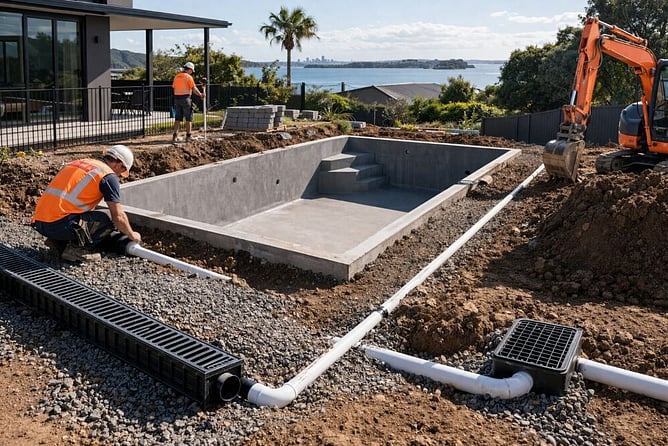
A pool project can look simple on a plan. In practice, it involves excavation, levels, runoff, retaining, hard surfaces, and trade sequencing. DrainPro’s Auckland drainlayers team work with homeowners, builders, and developers on drainage that keeps building projects moving without delays or unexpected costs.
That is why drainage should not be treated as a late-stage detail. Auckland Inground Pools a concrete pool building company, notes that pool projects usually involve at least four key trades, including drainage specialists, because the pool needs to perform properly over time. When drainage is pushed back until after the layout is fixed, rework becomes much more likely.
Start with site levels before the surrounds are locked in
The first big issue is finished levels. Builders need to know how water will move across the site before paving, coping, decking, or retaining details are finalised.
If those decisions are left too late, the drainage system often ends up fitting around the project instead of supporting it.
Auckland Inground Pools’ site-preparation guide makes the same point from the pool-builder side. Before any digging starts, engineering plans are prepared, and those plans cover structural integrity, plumbing, and safety requirements.
That early stage is also the right time to settle falls, collection points, and discharge paths.
Pool zones create more water than many people expect
Rain is only part of the story. Around a pool, there is also splash-out, backwash, and water tracked across nearby surfaces. Auckland Inground Pools recently noted that subtle grading, channel drains, and careful surface selection help move that water away efficiently.
That matters because the pool surround is often where performance problems first show up. Water that sits on paving or decking can affect nearby structures and foundations over time.
From DrainPro’s side, this is where hard surface drainage becomes important, including grated channels, stormwater pits, and filtration systems.
Rework usually starts when one trade plans in isolation
The pool shell is only one part of the job. Once excavation starts, builders also need to think about retaining, access, service runs, drainage routes, and the finished surface around the pool.
Auckland Inground Pools says pool builders, structural teams, and drainage specialists all have distinct roles in making the project perform properly over time.
Problems start when one part of that process is settled too early. A step may end up where a channel drain should sit. A paved area may direct runoff toward the pool instead of away from it.
A retaining wall may interrupt a water path that nobody resolved on paper. Those are the kinds of issues that create site delays and expensive changes.
Auckland sites need a practical, local approach
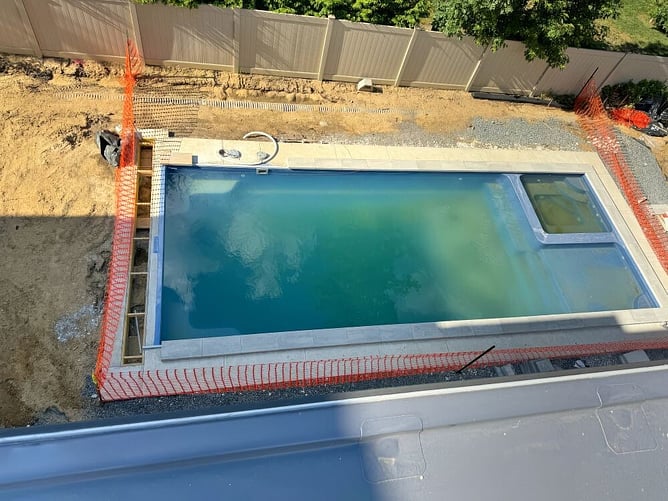
Auckland is not a one-condition market. Auckland Inground Pools points out that local sites often include sloped sections, clay-heavy soils, and areas prone to moisture retention. Those factors can affect how a pool settles and how water behaves below the surface.
The same source notes that intense rain events can overwhelm poorly planned systems, especially when the ground is already saturated. That makes early drainage planning even more important on Auckland sites, particularly in parts of the west and north where access, slope, and runoff can complicate the build.
DrainPro’s Auckland branch covers a wide area across Auckland North and West, including places such as Blockhouse Bay, New Lynn, Henderson, Massey, Kumeu, Hobsonville, Albany, Dairy Flat, Orewa, Warkworth, and Mangawhai.
That spread is another reminder that local site conditions should drive the drainage plan, not a standard detail copied from another job.
Product decisions should not come before site planning
Homeowners often focus first on pool shape, finish, and features. That is understandable, but the build still depends on the groundwork being right.
People researching swimming pool installation often start with design ideas, while the more important early questions are about access, excavation, levels, and how water will leave the area once the build is complete.
That is not a criticism of the pool process. It is simply the reality of complex outdoor projects. Auckland Inground Pools’ own content on site preparation and trade coordination shows that pool construction depends on planning well beyond the shell itself.
Good sequencing protects the budget
The cheapest time to solve drainage is before the surfaces go in. Once concrete, paving, coping, and landscaping are complete, even a small change can affect several trades. That slows the job and pushes costs up.
A better sequence is straightforward. Confirm the engineering and site plan first. Lock in the levels, drainage paths, and permanent structures next.
Then install the drainage before the visible finishes are completed. That gives builders, pool contractors, and drainlayers one shared plan to work from.
Final thoughts
Builders can avoid a lot of pool-project rework by treating drainage as part of the structure of the job, not as a final add-on. On Auckland sites, where slope, soil, rainfall, and access can all change the outcome, early coordination makes the whole project easier to build and easier to protect long-term.
Thinking of getting a concrete pool installed? Talk to us at Drainpro about your drainage now!