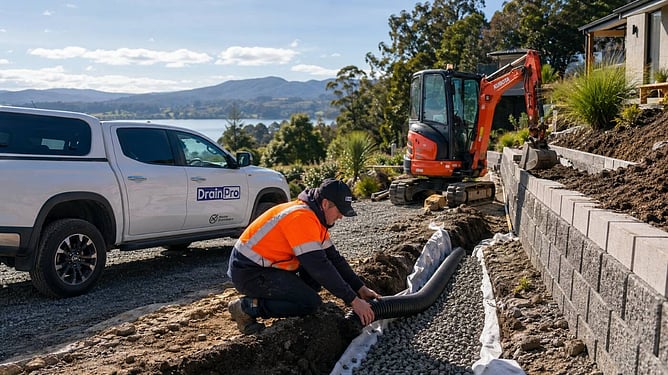
Good drainage for Rotorua properties is one of the most important parts of a successful landscaping project, but it is also one of the easiest things to overlook until a problem appears.
Retaining walls, paved areas, lawns, driveways, patios and garden beds all change the way water moves across a property. Once ground levels are altered or hard surfaces are installed, rainwater that previously dispersed naturally can become concentrated in one area, creating pooling, saturation, erosion or unwanted pressure behind retaining structures.
In Rotorua, this is particularly important because local soil conditions can vary significantly from one property to another. Pumice and volcanic soils often behave differently from heavier clay soils, so drainage needs to be designed around the actual site rather than treated as a standard add-on.
Planning drainage early helps create a system that works alongside the landscaping, rather than trying to fix water problems after the project is finished.
Why Good Drainage Matters for Rotorua Landscaping Projects
Every landscaping project changes how water behaves. Raising or lowering ground levels, installing a retaining wall, creating a new lawn area or replacing permeable soil with concrete and paving can all redirect rainfall.
Even small changes in levels may cause water to move towards a house, collect at the base of a wall or settle in an area that was previously dry. This is why drainage should be considered as part of the overall landscape design from the beginning.
In Rotorua, site-specific planning is especially important because of the area’s volcanic ground conditions. Pumice can allow water to move differently through the soil compared with dense clay, but that does not mean every property will drain well naturally.
Compacted ground, sloping sections, fill, existing structures and previous landscaping work can all affect how quickly water is absorbed and where it travels. We look at the whole property so we can understand how water is entering the site, where it is likely to collect and where it can be discharged safely.
Need help with your retaining wall drainage? Get in touch with our Bay of Plenty team:
Phone: 02102204924
Email: jordan@drainpro.co.nz
Every Landscaping Project Changes How Water Moves
Landscaping is often thought of as just a surface-level project, but the changes that are made above ground often have a direct impact on what's happening below ground as well.
A new driveway can increase runoff because water can no longer soak into the ground where it once did. A retaining wall can interrupt the natural path of groundwater.
Raised garden beds can redirect surface flow, while new lawns may sit at a lower level than surrounding paving and become a collection point during heavy rain. The most effective drainage solutions are usually those that are planned before construction begins.
When we can see proposed levels, retaining wall locations, paving areas and future planting zones, we can make informed decisions about where drains should be placed and how water should be directed. This gives us more options and helps avoid unnecessary work later.
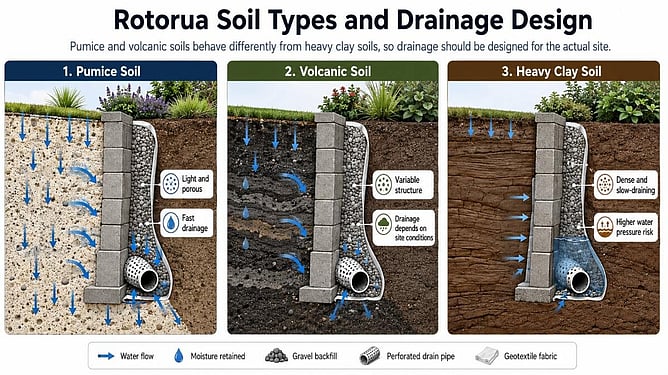
Rotorua Soil Conditions Need a Site-Specific Approach
No two properties behave exactly the same way. Even within Rotorua, soil structure, slope, groundwater movement and property layout can vary significantly. A drainage solution that performs well on one site may not be suitable for another only a few streets away.
That is why we do not rely on a one-size-fits-all approach. We assess how the land falls, where existing water collects, how surrounding properties sit in relation to the site and what landscaping is planned.
We also consider whether the ground is suitable for soakage or whether water needs to be captured and directed elsewhere. Good drainage starts with understanding the site rather than simply installing pipework and hoping it solves the problem.
Retaining Wall Drainage Protects More Than the Wall
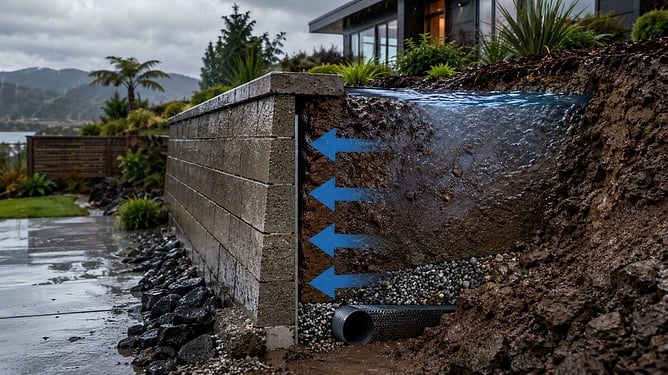
Retaining walls are built to hold back soil, but they can also hold back water if drainage is not incorporated correctly. When rainfall or groundwater moves through the soil behind a wall, it needs a controlled route out. Without that route, the soil can become saturated and pressure can build behind the structure.
This can lead to visible problems such as water seeping through the face of the wall, wet areas forming around the base, soil washing out from behind the structure or surrounding landscaping becoming persistently saturated.
Over time, uncontrolled water can add stress to the wall and contribute to movement or deterioration. Proper drainage helps manage this risk by allowing water to move away from the retained area in a controlled way.
What Happens When Water Builds Up Behind a Retaining Wall?
Water behind a retaining wall can create hydrostatic pressure, particularly when the backfill becomes saturated after prolonged or heavy rain. The wall is already supporting the weight of the soil behind it, so additional water pressure increases the load.
There are also practical landscaping issues to consider. Water may find its way around the ends of a retaining wall, emerge through joints or collect in the area below.
This can create muddy patches, erosion or damage to planting and lawn areas. If paving or a patio sits nearby, uncontrolled water may also travel across those surfaces rather than being collected through a proper drainage system.
Good drainage reduces these problems by managing both subsurface water and surface runoff.
How We Manage Water Behind Retaining Walls
The correct drainage method depends on the design of the wall, surrounding ground levels, soil conditions and the final destination for the collected water. In many cases, drainage aggregate and subsoil drainage are used behind the wall to create a path for water to move away from the retained soil.
Surface water also needs to be considered. A well-drained wall can still experience problems if large volumes of runoff are directed over the top of it. For example, water from a driveway, roof outlet or sloping lawn may concentrate behind the structure unless it is intercepted beforehand.
We consider the complete water path. That means looking at where the water comes from, how it moves through and across the property, how it can be collected and where it can be discharged without creating another issue elsewhere.
Landscaping Drainage Should Be Planned Before Construction Starts
Drainage is much easier to install while a site is still open. Once retaining walls, paving, lawns, concrete and garden features are complete, options can become limited.
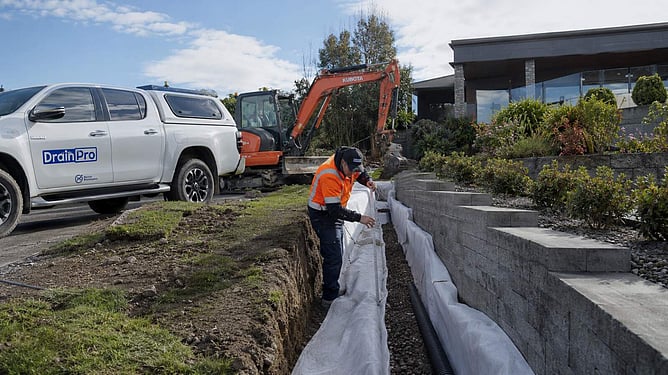
Retrofitting drainage may require finished surfaces to be lifted, landscaped areas to be excavated or newly completed work to be disturbed.
By planning early, we can install underground drainage at the most practical stage of the project and coordinate pipework with other trades. This is particularly valuable on larger landscaping projects where builders, landscapers, concrete contractors and drainlayers may all be working within the same area.
We can help you with this now!
Phone: 02102204924
Email: jordan@drainpro.co.nz
Finished Levels Determine Where Water Will Go
Water follows gravity, so finished ground levels play a major role in drainage performance. A few centimetres can make the difference between water flowing into a drain and water collecting against a building or retaining wall.
Before drainage is installed, we consider the relationship between lawns, paving, garden beds, driveways, retaining walls and building thresholds. We want water to move predictably towards suitable collection points rather than finding the lowest area by accident.
This is one of the reasons drainage and landscaping design should be coordinated. If drains are positioned before final levels are confirmed, they may end up too high, too low or in the wrong location. Good planning keeps everything working together.
Early Drainage Planning Helps Prevent Expensive Rework
Rework is often more disruptive than the original installation. Once concrete has been poured or landscaping has been completed, adding another drain can become a much larger job.
Planning drainage at the start allows us to think about future conditions rather than only what the site looks like today. If a new retaining wall, patio or driveway is being added, we can assess how those features will affect runoff before they are built. This can reduce the risk of needing to cut through paving, dig up lawns or reopen completed areas later.
For local builders and landscapers, early coordination also helps keep the project moving efficiently. Drainage can be installed at the right stage and checked before surfaces are closed in.
Choosing the Right Drainage for Different Outdoor Areas
Different parts of a property create different drainage challenges. A lawn does not behave the same way as a driveway, and the drainage required behind a retaining wall is different from the drainage needed around a patio.
The best results come from choosing a solution that matches the specific area and the way water behaves there.
Lawn and Garden Drainage
Wet lawns are a common sign that water is not moving away effectively. Some areas may remain soft long after rain has stopped, while others may develop standing water after even moderate rainfall. These problems can result from poor natural fall, compacted soil, groundwater movement or runoff from higher parts of the property.
Depending on the site, subsoil drainage may be used to help collect excess water and move it towards a suitable outlet. In other cases, reshaping levels or addressing runoff from surrounding surfaces may be part of the solution.
Garden areas also need careful consideration. While plants require moisture, constantly saturated soil can cause poor growing conditions and may allow water to migrate into adjacent lawns, walls or paved areas.
Paving, Patios and Outdoor Living Areas
Paved areas need controlled falls so rainwater does not sit on the surface or travel towards the house. Where natural fall alone is not enough, channel drains, pits or other collection systems may be needed.
This is particularly important around outdoor entertaining areas because even minor drainage problems become noticeable when people are regularly using the space. Ponding water, slippery paving and runoff across walkways can all reduce the usability of an otherwise well-designed area.
We look at how the paving connects to the rest of the site and ensure drainage is designed as part of the overall layout.
Driveway and Hard-Surface Drainage
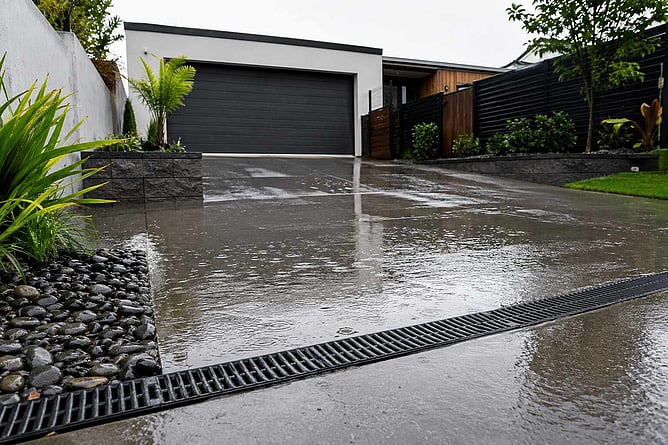
Driveways and other hard surfaces can produce significant runoff because water cannot soak into them. The larger the paved area, the more important it becomes to manage where that water goes.
Grated channels and stormwater pits can be used to collect runoff at suitable points for driveway drainage, but their position and discharge route need to be carefully planned. A channel drain only solves the problem if the water it collects has somewhere appropriate to go.
We also consider the slope of the driveway and whether runoff could travel towards a garage, house entrance, retaining wall or neighbouring property.
Sloped Property Drainage
Sloping sites can create concentrated water movement, particularly during heavy rainfall. Water flowing downhill can gain speed, pick up soil and debris and place pressure on lower sections of the property.
On these sites, drainage may need to intercept water before it reaches vulnerable areas. This could involve subsoil drainage, surface collection or a combination of solutions depending on the ground conditions and layout.
The key is to work with the natural contours of the land rather than ignoring them.
Where Should Landscaping and Retaining Wall Water Go?
Collecting water is only one part of the drainage process. The next question is where that water will go.
A drainage system needs a suitable discharge point. Depending on the property, this could involve an approved stormwater connection, soakage or another site-specific solution. The correct option depends on local conditions, available infrastructure and the volume of water being managed.
We avoid solving one problem by creating another. Redirecting water away from a retaining wall is not useful if it simply causes a new wet area further down the property. The entire route needs to be considered.
Why We Look at the Whole Property Before Installing Drainage
When assessing a drainage project, we look beyond the immediate problem area. A wet lawn may actually be receiving runoff from a driveway above it. Water emerging beside a retaining wall may be connected to groundwater or drainage higher on the site. Pooling around a patio may be caused by surrounding ground levels rather than the patio itself.
By looking at existing drainage, natural contours, soil conditions, buildings, retaining structures and future landscaping, we can identify the most practical solution.
This whole-site approach is particularly important on properties that have been developed in stages, because previous landscaping work may already have changed the natural drainage pattern.
Common Drainage Mistakes We See Around Landscaping Projects
Many drainage problems can be avoided with better planning. One of the most common issues is waiting until landscaping is complete before thinking about water movement. By that point, the options are often more limited and more disruptive.
Another mistake is assuming that every retaining wall can use the same drainage detail. The correct design depends on wall size, ground conditions, slope and surrounding surfaces. Surface water should also be considered separately from groundwater.
It is also important not to direct collected water into another part of the property without understanding the consequences. Moving water away from one area can easily create a new problem elsewhere.
Finally, surface drainage should not be expected to solve every issue. A property may have good surface falls but still experience saturated ground due to subsurface water. Effective drainage often requires us to understand both.
When Should You Bring a Drainlayer Into a Landscaping Project?
The best time to involve a drainlayer is usually before the landscaping is built. If we can review the plans while retaining walls, paving, driveway locations and finished levels are still being decided, we have more flexibility to create an efficient drainage solution.
This is especially valuable when several trades are involved. Builders, landscapers and drainlayers can coordinate excavation, underground services and final levels before areas are closed in.
Before Building a New Retaining Wall
Drainage should be considered at the same time as the retaining wall itself. This allows subsoil drainage, backfill and outlets to be incorporated while the area is accessible.
Before Major Paving or Landscape Construction
Underground drainage is much easier to install before concrete, paving and lawns are finished. Early planning can also help ensure collection points are positioned at the correct level.
When Existing Landscaping Stays Wet
If a lawn remains boggy and wet, water regularly pools after rain, erosion appears around retaining walls or the same wet areas keep returning, it’s worth investigating the cause rather than repeatedly treating the surface.
Why Local Drainlayers in the Bay of Plenty Matter for Rotorua Projects
When choosing drainlayers Bay of Plenty property owners can rely on, local knowledge is an important part of getting the right result. Rotorua properties can present very different drainage conditions from coastal or low-lying sites elsewhere in the region. Volcanic soils, varying contours, established landscaping and differences in soakage all influence how drainage should be designed.
We approach each site individually. Rather than applying a generic detail, we look at what the water is doing on the property and how the proposed landscaping will change that behaviour. We consider the land, the structures, the soil and the available discharge options before recommending a solution.
That practical, site-specific approach is particularly important for retaining walls and landscaping projects because drainage is often hidden once the work is complete. It needs to function reliably without becoming something the homeowner has to continually think about.
We Design Around the Site, Not a Generic Detail
Effective drainage is about more than installing pipes. It is about understanding how a property works as a complete system.
We consider where water is coming from, how it moves, where it can be intercepted and where it can safely go. We also think about how future landscaping, paving or building work may affect the site.
For Rotorua homeowners, builders and landscapers, this means drainage can be incorporated as part of the project rather than treated as a last-minute fix.
Plan Your Rotorua Drainage Before the Landscaping Goes In
Retaining walls and landscaping can transform how a property looks and functions, but they also change the way water moves across the site. Planning drainage early helps protect those improvements and reduces the chance of pooling, saturated ground, erosion and unnecessary rework.
Whether the project involves a new retaining wall, lawn, patio, driveway or full landscape redesign, the best results usually come from considering water movement before construction begins.
By assessing levels, soil conditions, runoff and suitable discharge options at the start, we can design drainage that works naturally with the finished landscape.
If you are planning landscaping or retaining wall work in Rotorua and need experienced drainlayers Rotorua and Bay of Plenty property owners can work with, we can assess the site, review the proposed layout and help determine the right drainage approach before the project gets underway.
Get in touch with DrainPro's Bay of Plenty drainlaying experts for all your drainage needs.
Phone: 02102204924
Email: jordan@drainpro.co.nz