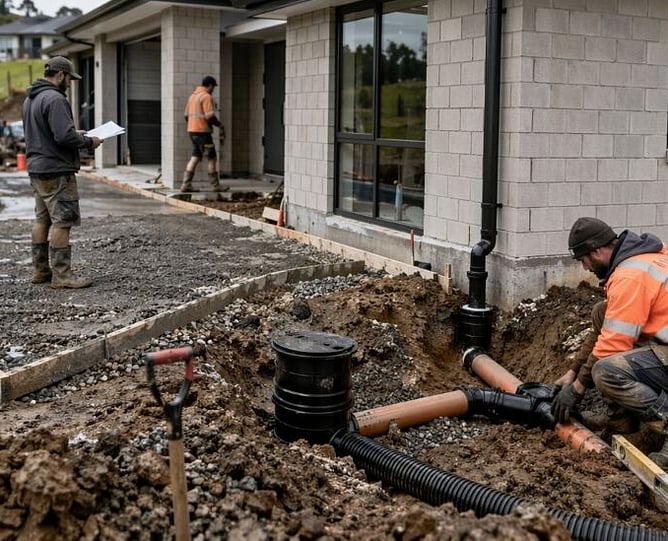
On most home projects, roofwater and ground drainage are treated as separate jobs. One sits above the soffit line. The other disappears below ground. In practice, they need to work as one system from the start.
At DrainPro Hamilton & Waikato, we work with homeowners, builders, and developers on new residential drainage and related site works. Our role is usually below ground, but the outcome depends on what happens above it as well. When guttering, downpipes, paving, and stormwater are planned in isolation, delays and rework become more likely.
That is especially true across Hamilton and the wider Waikato. DrainPro’s Hamilton service area includes places like Cambridge, Te Awamutu, Raglan, and Morrinsville, where new homes and upgrades often involve a mix of hard surfaces, tight access, and staged trade sequencing. Fine Line also operates from Hamilton and works across Waikato on fascia, spouting, and downpipe installation.
Start with the full water path
Builders often focus first on visible items. Roofline, cladding, joinery, and exterior finishes tend to drive the schedule. That makes sense, but water does not care which trade installed which part. It will follow the path the site gives it.
A good plan starts by tracing roofwater from collection to discharge. That means looking at the gutter profile, downpipe positions, collection points, underground connections, surface falls, and any nearby paving or landscaping. If one part of that path is guessed late, the rest of the job can become harder to coordinate.
Downpipe locations should not be an afterthought
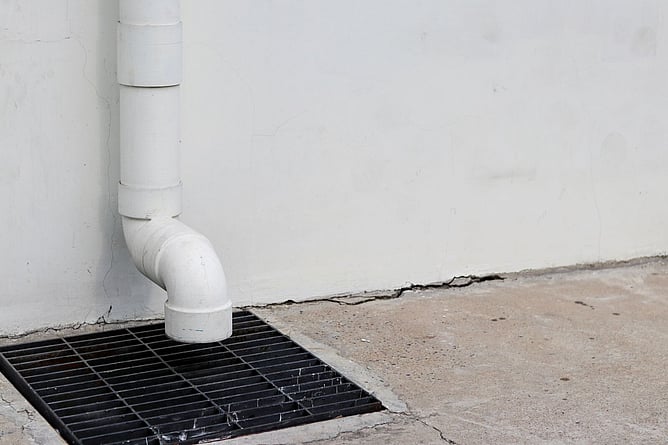
Downpipes are small compared with the rest of the build, but they affect more than people expect. Their position influences underground pipe runs, trench locations, finished levels, and where other exterior work can sit. A downpipe that looks fine on an elevation can still create awkward drainage work on site.
This is why builders should confirm downpipe placement early. Fine Line’s Hamilton material shows how spouting and downpipes are selected in different sizes, colours, and formats to suit the project. That above-ground choice needs to line up with the stormwater layout below ground.
When owners are comparing Hamilton guttering options, they are often also making decisions that affect downpipe position and roof water collection. Those decisions should be checked against the drainage plan before paving, paths, or garden edges lock the layout in.
Trade sequencing matters more than most people think
Drainlaying works best when access is still open and levels are still flexible. DrainPro notes that laying and backfilling can be completed quickly, which helps reduce site downtime and keep the build ready for the next stage. That advantage only holds when the sequence is planned properly.
If guttering is installed without confirming discharge points, later connections can become messy. If paving is poured before roofwater routes are finalised, new cuts or extra trenching may follow. Small timing issues can ripple through the programme, especially on tighter Hamilton sites where there is less room to adjust.
Across Waikato, we often see this on projects where multiple exterior trades overlap. Fascia, spouting, downpipes, drainage, driveways, and landscaping may all be correct on their own. Problems usually appear when they were not coordinated as one connected system.
Renovations need the same discipline
This is not only a new-build issue. Gutter replacement, respouting, and internal-to-external conversions can also change how roofwater is handled around a home. Fine Line’s Hamilton site makes clear that its work includes repairs, replacements, respouts, and conversions, which can all alter discharge points and water movement.
Once those changes happen, the below-ground drainage should still make sense. A better roofwater system above ground will not solve a poor runoff path at ground level. Builders and owners need to check whether the updated downpipe layout still suits the stormwater plan, especially before new paving or landscaping goes in.
Builders save time when the system is planned as one job
The practical lesson is simple. Roofwater should not be handed over from one trade to the next without a full site check. Guttering, downpipes, underground stormwater, and finished levels should be reviewed together while changes are still easy to make.
For Hamilton homes, that joined-up approach protects both programme and finish. It reduces rework, supports cleaner installation, and gives the site a better chance of handling water properly long after handover. From our side, that is the difference between a smooth drainage job and one that has to be corrected later.
Talk to us at Drainpro now for all your drainage needs.