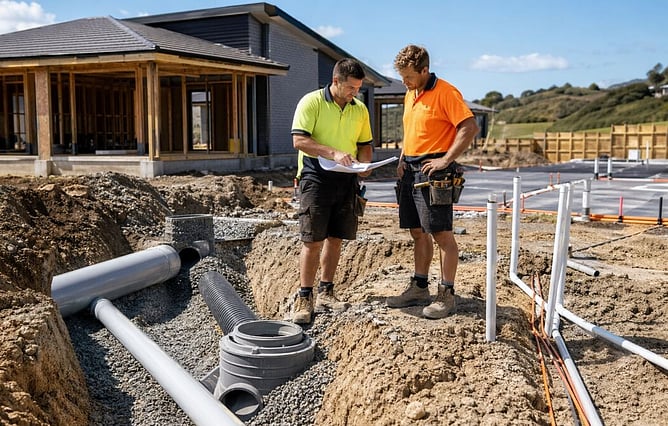
Modern new builds rely on more site services than ever before. It is no longer just a case of getting the structure up and finishing the fit-out. Homes now need drainage, wastewater planning, electrical infrastructure, smart-ready systems, and room for future upgrades from the start.
At DrainPro, we work with builders and homeowners across multiple New Zealand regions, with drainlayers in Auckland and Waikato, Bay of Plenty, Christchurch and Central Otago, on new-build drainage, drainage solutions, septic tank installations, and wastewater systems.
That work often sits below ground, but it still affects how the rest of the project comes together. Good service coordination early on usually means less rework later.
Modern builds need a bigger planning mindset
A lot of avoidable project stress starts when services are treated as separate tasks. Drainage gets planned first, electrical comes later, and future upgrades are left for another day.
On paper, that can seem manageable. On-site, it often leads to clashes in timing, layout, and access.
SES Electrical in Palmerston North makes a useful point on this from the electrical side. Its fit-out guidance says modern projects now need to account for lighting, heating, solar, EV charging, CCTV, access control, and home automation as part of the building's hidden infrastructure.
That reflects a wider shift across New Zealand builds. More homes are being designed to do more from day one.
Drainage decisions affect more than the trench
Drainage planning can shape the programme earlier than many people expect. DrainPro positions its work around new-build drainage, septic tank installation, and wastewater solutions, with compliance and paperwork also forming part of the service.
That matters because drainage does not just affect what happens underground. It affects sequencing, inspections, site readiness, and the timing of other trades such as electrical and plumbing around it.
On some builds, that means confirming drainage routes and wastewater requirements early enough that later changes do not disrupt finished areas.
On others, it means making sure the site is ready for the next stage without delays caused by paperwork or redesign. In both cases, the practical lesson is the same: drainage decisions are easier and cheaper when made early.
Electrical planning is no longer just about power points
Electrical planning has changed, too. SES Electrical are Palmerston North electricians who describe their work as covering complete electrical fit-outs, solar installations, security solutions, smart home automation. As well as future-ready design for new builds, residential developments, and commercial spaces. That is a much broader role than simply wiring lights and switches.
Its fit-out article also notes that retrofitting later can mean cutting into lined walls, upgrading undersized switchboards, or forcing extra cabling into poor locations.
That is a strong reminder that future-proofing is often really about early planning. Even if a homeowner is not installing every feature straight away, the infrastructure can still be allowed for while the build is open and flexible.
Service coordination reduces rework
This is where the real value sits for builders. When drainage and electrical planning are coordinated from the start, the job usually becomes cleaner to manage. Builders can sequence site works with fewer interruptions.
Homeowners get a clearer path for future upgrades. Tradespeople spend less time working around changes that could have been avoided. This is an inference based on both companies’ emphasis on early planning, compliance, and integration.
That coordinated thinking matters more on modern projects because new homes now carry more infrastructure. Wastewater systems, drainage layouts, guttering, switchboard capacity, solar readiness, security wiring, and automation all need space in the plan.
If one part is handled too late, the rest of the project can lose time around it.
Future-proofing starts before the walls are lined
Future-proofing is often treated like an optional extra. In reality, it usually means making a few smarter decisions while the build is still easy to change.
SES Electrical talks about allowing room for solar, battery storage, and smart connectivity during early fit-out planning. That kind of thinking applies more broadly across site services, too.
For drainage, future-proofing may mean choosing the right wastewater approach for the site, allowing for compliance requirements, and making sure the below-ground system suits the actual long-term use of the property.
For electrical, it may mean designing for expansion rather than the bare minimum needed on handover day. These are different systems, but the planning principle is the same.
Nationally, the smarter builds are the ones planned as one project
This is not just a regional issue. It reflects the way new homes are being built across New Zealand.
DrainPro’s national-style footprint across Auckland, Waikato, Bay of Plenty, Central Otago, and Christchurch, alongside SES Electrical’s focus on integrated residential and commercial electrical systems, points to the same practical trend: builders are dealing with more specialised services that need to line up properly from day one.
That is why the strongest projects are usually the ones that treat drainage, electrical, and future upgrades as connected parts of one build.
It creates a smoother programme, reduces rework, and leaves homeowners with a property that is easier to live in and easier to upgrade later. This final point is an inference from the planning and integration guidance on both sites.
Better outcomes start with earlier coordination
For builders and homeowners, the message is simple. The earlier service coordination begins, the easier the rest of the project tends to be.
Drainage and electrical work do not need to compete for attention, but they do need to be planned with the same long-term view.
Smarter new build planning starts by seeing the home, its infrastructure and even its landscaping as one connected system. When drainage, electrical design, and future-proofing are considered from day one, the end result is usually simpler, stronger, and far better suited to how modern New Zealand homes are expected to perform.
Talk to our team at DrainPro for all your drainage requirements.
Email: office@drainpro.co.nz
phone: 03 342 1278